The Bilt 2.0 Product Disaster
A case study in what not to do when your product has to get worse.

How to Destroy Customer Trust in Three Months
I've spent my career building products. And the thing I've learned more than anything is that building stuff is really, really hard. Getting something to work, to actually deliver value to a real person, to make the economics sustainable... most companies never figure that out. It's why so many businesses fail.
So I genuinely don't want to sit here and trash a company that's trying to build something. But what Bilt just did to its customers is probably the worst consumer product launch I have ever seen. It was so bad that I think it’s useful as a “how-to” on what not to do to your customers.
What Bilt Was
If you're not familiar, Bilt started with a simple premise: earn rewards on your single largest monthly payment, housing.
The model they were going for was already familiar to most consumers. You go to the grocery store, you swipe a credit card, you earn rewards points. Bilt was trying to make your rent or mortgage payment work the same way. Swipe the card, pay your rent, earn points, all with no fees. It slotted right into a behavior that people already understood and were already doing with every other major purchase in their lives.
And that's essentially the same pitch they made to the credit card companies, because that's how the economics work on their end too. Banks make money when people use credit cards. More transactions, more interchange fees, more interest from carried balances. Bilt was offering them a massive new spending category to tap into, one that had never been on a credit card before.
So, Bilt partnered with Wells Fargo to bring the vision to life.
To me, this was great. Housing was my largest spend, so why not also get rewards on it?
What Went Wrong
When Bilt pitched Wells Fargo on this partnership, the sell was pretty straightforward. It would bring in a new, elusive demographic to the aging bank. Bilt’s customers were largely young renters in their 30s with high credit scores.
To make the economics work, Wells Fargo was banking on what, in hindsight, was a very large assumption. That once the user became a customer they would use this card for other things than their rent.
The card is not profitable on its own with this singular rent payment. They needed users to swipe it a lot and in some cases carry balances. The demographic that was savvy enough to use this card however, were not going to do that.
For example, I fell into this bucket. When I got the Bilt card, I got it for its main value prop: rewards on rent. I already had other cards for other rewards. I was a “rewards-optimizer.”
Bilt tried to circumvent this problem with a transaction minimum. To gain eligibility for rent rewards you needed to use your card five other times outside your rent.
It was a noble effort, but more of an annoyance than a benefit. For example, I would hit the minimum, but always on the smallest possible items. Quick runs into the grocery store for blueberries or bananas. Maybe a stick of gum or an energy drink at 7-Eleven. Bilt was never a card I seriously considered for anything other than rent.
Apparently, most others felt like me.
Wells Fargo projected that roughly 65% of purchase volume would come from non-rent spending. They got the inverse. Only about 35% was non-rent. People like me were making five small purchases per billing cycle to hit the minimum, and then doing nothing else with the card. Wells Fargo also expected cardholders to carry balances, but the average Bilt user had a FICO score around 760 and paid their bills in full every month. Ironically, this highly coveted demographic was also allergic to revolving debt.
Meanwhile, Wells Fargo was paying Bilt $200 for every new card account and 0.8% on each rent transaction where they collected zero interchange fees.
The result was that Wells Fargo was reportedly losing up to $10 million per month. By mid-2024, reports came out that they were trying to renegotiate. By July 2025, they announced they were ending the deal early, years ahead of the original 2029 expiration.
Because of this miscalculation of their customers' actual behavior, the economics just didn't work for the banks. And for Bilt, the writing was on the wall: a “rent-only” credit card was not economically viable. So Bilt embarked on a campaign to not only overhaul their entire business model, but to convince you that the changes were actually a good thing. (SPOILER — they weren’t)
What Bilt Did Next
Starting around November 2025, Bilt began promoting “Bilt 2.0,” their attempt at a reset.
But instead of clear communication, it felt like a case study in outdated marketing dogma: never deliver bad news directly. The end of the Wells Fargo partnership was never plainly explained. Instead, they framed an overhauled rewards structure as the next major evolution of the product. What customers got was confusion. NerdWallet would later describe the new system as “the most complicated rewards system we've seen.”
I tweeted about their January 14th launch video because the whole thing felt off. And the public reaction confirmed it. The comments on the video were brutal. People writing things like "Can you just tell us what the cards are?" and "I just wanted a card for rent." Someone called it "Fyre Festival 3.0." One commenter got hundreds of upvotes for writing, "I like the part where you explained the rent (the only feature everyone's here for)."
The backlash was so bad that just 48 hours after the January 14th launch, CEO Ankur Jain sent an email acknowledging "real and reasonable confusion" and announced a second earning option on top of the one they'd just launched. Which only made things more confusing.
To top it off, one of Bilt's executives posted a meme on social media referring to upset customers as "basement-dwelling redditors trying to cheat their rent system." For those at home, that means customers who used the card for the exact thing it was marketed for are somehow the problem, not the company that spent three months trying to hide that the product they sold you no longer exists.
The Consequences
In the end, it seems what they were trying to hide through the complex reward systems was that they were conceding that paying your rent with credit was unsustainable. And in the months leading up to the launch, it seemed they were doing all they could to avoid telling us that.
After the February 7 launch, I got an email that didn’t sit right. The wording was strange enough that I went straight to the help docs to see what they weren’t saying outright.
What I found was simple: rent was no longer a credit transaction.
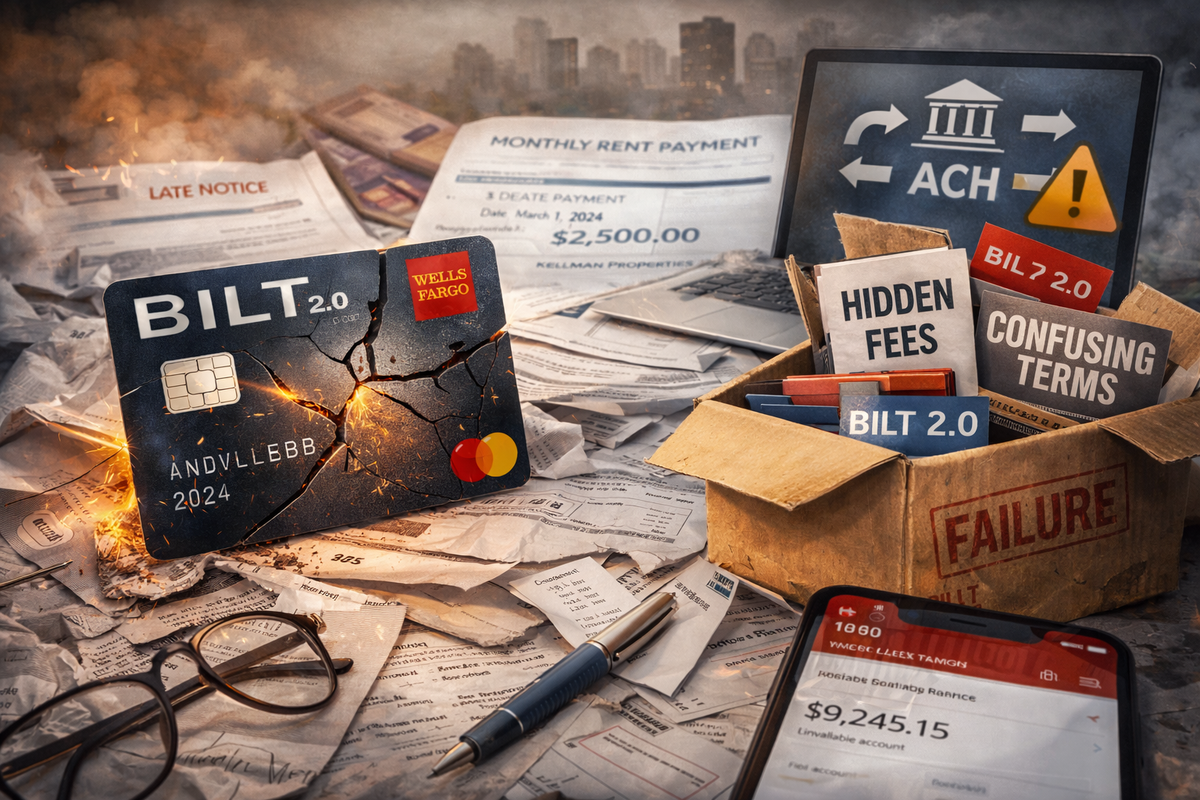
The new "Bilt Card" for rent pulls directly from your bank account via ACH. It turned into a pseudo-debit card for your rent and a credit card for everything else.
This is a fundamental restructuring of the entire product. To make it worse, they dressed it up in language like "your rent payments won't use your credit line," trying to frame it as if they were doing you a favor. Like freeing up your credit line was the thing you were worried about when you signed up for a credit card only to pay your rent.
What this looked like for me will undoubtedly happen to thousands of others.
On February 1, I paid my rent the way I always had, charged to the credit card.
Two weeks later, emails started arriving saying rent payments “won’t count against your credit.” Starting March 1, it would be pulled directly from my bank account via ACH. The cash had to be there immediately.
So when March 1 arrived, I effectively owed two rents at once. I still had February’s balance sitting on the credit card, due on the normal billing cycle. At the same time, March’s rent had to be sitting in my checking account, ready to be pulled.
If they had communicated this months earlier, I would have adjusted. I might not have liked it, but I could have planned for it. Instead, I found out roughly 15 days before it mattered. I was able to move things around and absorb the liquidity hit, but I can’t believe this wasn’t the first thing they told customers months in advance.
How It Could Have Been Handled
This is the product lesson, and it's why I'm writing this. When your business model breaks and you have to make changes that are worse for the customer, you really only have one play: be transparent about it.
Here's the email Bilt should have sent:
"Our partnership with Wells Fargo is ending. The economics of offering rent payments on a credit card didn't work, and we need to move to a new model. Starting in March, rent payments will be pulled directly from your bank account via ACH instead of being charged to your credit card. This means you'll need the funds available at the time of payment. If you're carrying a balance from your last month on the Wells Fargo card, plan accordingly because you'll need to pay that off and have your next month's rent available in your bank account at the same time. We know this is a big change, and we wanted to give you as much time as possible to prepare."
Just tell people what’s happening. You might lose a few customers, but losing trust is way worse, especially when you’re asking someone to route their largest monthly expense through your platform. Once it’s broken, resentment isn’t far behind.
Bilt was clearly terrified of delivering bad news. So they tried to spin everything into a positive. But there are some things you just can't spin, especially when you're fundamentally downgrading the core product that every single one of your customers signed up for.
Respect the Customer
The CEO said it himself in his mea culpa letter: "We move fast at Bilt. That means we won't always get everything right the first time." I don’t think the issue here was about moving fast though. It was about deliberately hiding the most important piece of information from the people who needed it most, and hoping nobody would notice. This was about trying to spin everything into a positive when sometimes consumers just need to know what is going on.
In the end, consumers smelled it too. Never treat your customers like they’re dumb. I don’t think that has ever worked out well for anyone in the long run.
Building products is hard. I said that at the top and I mean it. The Wells Fargo partnership falling apart wasn't entirely Bilt's fault. The economics were bad from the start because they both made bad assumptions about user behavior. Bilt was in a genuinely difficult position, and I have sympathy for that. Unfortunately, many companies hit a point where they have to make the product worse to make it work. That’s when you find out how much they respect their customers.
If my building didn't use Bilt as their payment processor, I would never use a product of theirs again. And that's the actual cost of failing that test. You create a customer who will never believe a word you say again.